Before the Sitcom: How Radio Comedy Made a Room
Radio comedy made rooms audible through dialogue, sound and silence. Learn how a few precise cues can clarify a scene and sharpen its comic timing.
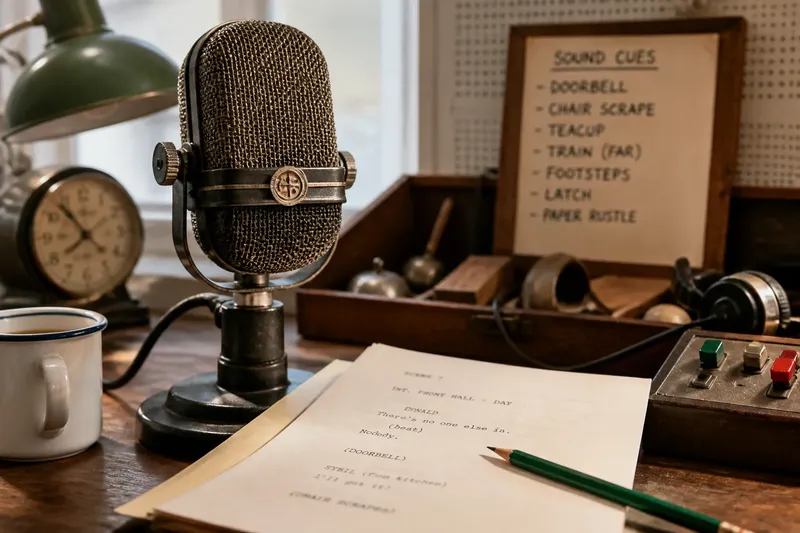
The common mistake in radio comedy is to treat the microphone as a missing camera. The result is a room listeners cannot place, described in lines that stall the joke. Radio comedy made settings audible by choosing which sounds and behaviours mattered, then trusting the audience to imagine the rest.
How did radio comedy establish a room?
In the early years of British broadcasting, comedy had to work through voices and sound rather than a visible set. The BBC’s ITMA, which began in 1939, used a rapid succession of characters and sound effects to suggest a bustling world. Later, The Goon Show, first broadcast in 1951, made its absurd settings part of the joke, using sound effects and verbal invention to move listeners between improbable places.
These programmes did not rely on one universal recipe. Their different styles show how a broadcast could establish a place with a few recognisable details, or deliberately unsettle it. A sound might locate a scene, interrupt a character’s claim or make an unlikely event feel momentarily real.
What can one well-timed sound do?
A doorbell can place a listener in a front hall. A train’s clatter can frame a conversation in motion. The cue need not reproduce an entire environment; it needs to be distinct enough for the dialogue that follows to attach to it.
Timing changes its meaning. A knock before the first line may orient the scene. The same knock after a boast can undercut it. Imagine a character insisting that nobody else is home as a second cup is set down nearby. The invented action gives listeners a contradiction to notice, and the character’s confidence becomes the comic target.
Use the sound as an event, not a layer of decoration. A chair scraping during a careful announcement can expose discomfort; a steady wash of indistinct bustle may simply make speech harder to follow. Leave space before and after a cue so listeners can register it and hear the response.
How can dialogue reveal a room naturally?
Characters rarely need to list the furniture. They can complain about a draught, ask someone to move a chair or warn a visitor about wet paint. Those remarks reveal the place while showing what each person wants.
One character might call a cupboard an office to impress a caller; another might point out that it is also where the coats go. The disagreement supplies a room and a relationship at once. Keep a setting detail when it changes behaviour, status or expectation; cut it when it merely repeats what the audience already heard.
Which details make an invisible setting easy to follow?
Choose details that affect movement or decisions. A jammed window matters when papers blow away. A crowded table matters when two people cannot avoid sharing space. Introduce details as the characters encounter them, rather than reciting a list before the scene begins.
Say you are writing an invented scene in a dentist’s waiting room. One character tries to whisper; the other keeps asking whether the clock has stopped. A squeaky chair interrupts every shift. The resulting scene gives the audience three clear clues—whispering, the clock and the chair—and lets those details create tension without a narrator describing the room.
How do silence and distance shape the scene?
A pause after someone calls into another room can suggest an empty space, or a person choosing not to answer. A voice farther from the microphone can imply a corridor; a close reply can feel intimate or intrusive. Make the contrast consistent enough to follow, then change it only when the scene gains something from the shift.
Silence can also give a punchline room to land. If effects continue beneath every line, they may flatten the rhythm. Let the track go quiet after an ill-judged remark, then use a small sound—a chair creak or a swallowed breath—to expose the awkwardness.
How can a recurring sound make a room memorable?
A latch that clicks reluctantly or a radiator that knocks can become a familiar signature. Bring the cue back with a changed consequence: the latch might interrupt an entrance in one scene and trap someone who is trying to leave in another. The audience recognises the place, while the sound continues to serve the action.
Continuity matters. Performers should remember where the door, stairwell or other sound source sits in the imagined room. Stable spatial choices help listeners follow who can hear whom, even when the set remains unseen.
What should you listen for in a radio-comedy room?
Does radio comedy need a narrator to describe the setting?
No. Characters can reveal a place through what they touch, avoid or misunderstand. A narrator can suit a particular style, but should add a point of view rather than repeat information already supplied by dialogue and sound.
How many sound effects should a scene use?
Use a cue when it clarifies where an action happens, changes the timing or gives the audience information. If it does none of these things, remove it and check whether the dialogue becomes easier to follow.
How can dialogue suggest a room without sounding artificial?
Give characters a practical reason to mention a feature, such as a blocked doorway or a draught. If the detail affects what someone wants or does, it is more likely to feel like part of the conversation than an explanation for listeners.
How can a writer check whether the setting is clear?
Read the scene aloud and listen for entrances, interruptions and changes in distance. If one movement is hard to follow, add a cue or a character’s response at that moment rather than a general description at the start.
What does radio leave for the listener?
A broadcast does not need to specify every chair, wall or patch of weather. It needs to establish who is present, what they can hear and which detail changes the exchange. The listener supplies the rest, building a private version of the room that can shift with every voice and pause.
That is why a small sound can carry more weight than a full catalogue of furnishings. In radio comedy, the most useful room detail is the one that changes how the next line is heard.